Most warehousing operations will use one of two main forklift battery types: lithium-ion batteries (Li-Ion) and lead-acid batteries. Of these two options, which is the most affordable forklift battery?
If you're wondering which option is right for you, it all depends on what your operational needs are.
Read on to find out how each type of forklift battery is used, their different benefits, and what you need to think about before you decide which option is right for you.
Related read: Key Questions You Should Consider Before Buying Your Next Forklift
What are lead-acid batteries?
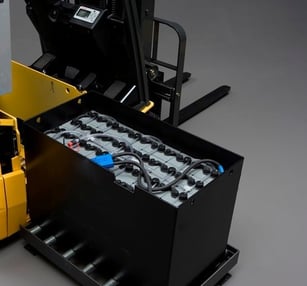
Invented in 1859, lead-acid batteries are known as the more traditional battery type. They’re a tried and tested solution in the material handling industry and have been used for decades in forklifts and elsewhere. They utilise the same technology many of us have in our cars.
A lead-acid battery that you buy now is a little different to one that you could have bought 50 or even 100 years ago. The technology has been refined over time, but the fundamentals haven’t changed.
Download now: Checklist: 5 Ways to Prepare Your Warehouse for Electrification 2030
What are lithium-ion batteries?
Invented in 1991, Li-Ion batteries are a much newer solution. Mobile phone batteries utilise lithium-ion, and Li-Ion can be recharged much faster than other commercial battery types.
Lithium-ion batteries are best known for their environmental benefits, higher efficiency, and faster, more flexible charging. They typically use around 30% less energy than lead-acid, contributing towards a lower total cost of ownership (TCO), can be opportunity charged during breaks, and offer a longer service life in demanding applications.
While they are more expensive than lead-acid batteries upfront, Li-Ion batteries are more cost-effective to maintain and use. Even though the initial investment is higher, some businesses could save money in the long run due to the lower operational and maintenance costs.
A note on nickel-cadmium
A third type of forklift battery exists: nickel-cadmium. However, they are costly and can be difficult to handle. They’re ultra-reliable and are right for some businesses, but for most, lead-acid or lithium-ion will prove more economical.
Lead-acid batteries in the warehouse
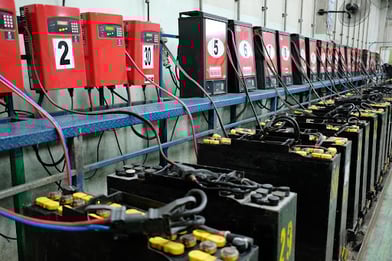
Where a business is operating multiple shifts, a fully-charged lead-acid battery will be installed onto each truck at the start of the shift on the understanding that it will last for the duration. At the end of the shift, each forklift battery will be removed for charging and replaced by another fully charged battery. This means that each forklift battery has enough time to be charged again before the next shift begins.
Given their lower cost to purchase, this means that lead-acid batteries can be a more economical choice for businesses with a single-shift operation.
Broadly speaking, lead-acid batteries are less expensive to buy upfront but may well end up costing you more over five years, while Li-Ion has a higher upfront purchase price but is potentially more cost-effective in the long run.
If you're wondering which option is right for you, it all depends on what your operational needs are.
Read on to find out how each type of forklift battery is used, their different benefits, and what you need to think about before you decide which option is right for you.
Related read: Key Questions You Should Consider Before Buying Your Next Forklift
Lithium-ion batteries in the warehouse
Li-Ion batteries are designed to stay in the forklift – they do not need to be removed for recharging. They can also be charged throughout the day, so when an operator stops for a break, they can plug their truck in to charge and come back to a recharged battery capable of running for the remainder of the shift. With TCM’s latest generation of Li-ion batteries, a full charge can be achieved in around two hours using fast charging.
They work exactly like a mobile phone battery. If your phone battery drops to 20%, you can charge it for 30 minutes and, while it won’t be fully charged, you can still use it properly.
Lithium-ion batteries usually have a much smaller capacity than the equivalent lead-acid battery. A lead-acid battery might have a capacity of 600 ampere-hours, while a Li-Ion battery might only have 200.
However, this isn’t a problem, because a lithium-ion battery can be quickly recharged throughout each shift. TCM’s new generation of Li-ion batteries makes the process much smoother, with a built-in battery management system (BMS) to show users all critical battery functions in real-time, including remaining charging time and fault alarm.
Thanks to their sealed, maintenance-free design, these batteries no longer require dedicated battery rooms or specialist ventilation, allowing chargers to be located much closer to where trucks actually work.
Lithium-ion batteries are therefore the more economical option for warehouses running 24/7 operations or multiple shifts back to back, because fewer forklift batteries are required compared to lead-acid types and batteries can be opportunity charged, enabling operators to run electric forklift trucks indefinitely around their breaks, increasing productivity and boosting efficiency.
Related read: How Electrification Can Enhance The Efficiency of Material Handling
How long does a forklift battery last?
TCM’s latest generation of Li-ion batteries is designed for a service life of up to around 4,000 charging cycles, with high capacity retention, while typical lead-acid batteries deliver approximately 1,000 to 1,500 cycles before reaching the end of their useful life.
That sounds like a clear win for lithium-ion batteries, especially in high-energy, multi-shift and 24/7 applications where opportunity charging is used to keep trucks running throughout the day. Unlike lead-acid, Li-ion is not negatively affected by frequent partial charges, so charging during breaks helps minimise downtime while preserving long-term performance.
Lithium-ion batteries are lower-maintenance than lead-acid batteries, which can mean they last longer before they reach their end of life. Lead-acid batteries need to be kept topped up with water to protect the lead plates inside them, and they will become damaged if they are allowed to get too hot or too cold. Li-ion batteries, by contrast, are sealed units that require no watering or acid checks and are far less sensitive to incorrect routine maintenance.
Download this free guide to discover how to assess your application requirements, balance acquisition and fuel costs, and understand the different types of material handling equipment currently available.
Which is the most economical forklift battery for your operations?
The cost of each type of battery needs to be worked out around your operations’ needs, budget and circumstances. If you have a single-shift operation, a low forklift count and space to charge batteries, lead-acid might be more economical. If you have multiple shifts, a larger fleet and little space or time to deal with removing and recharging forklift batteries, lithium-ion might work out more cost-effective.
Li-Ion batteries can be recycled, but the process is a lot more involved and potentially more expensive than the likes of lead-acid. When considering the option to recycle lithium-ion batteries, customers are advised to inquire with their suppliers regarding their established recycling programmes. It is expected that any reputable supplier would have a well-defined system in place, with the possibility that the associated costs may not be passed on to the end user.
TCM’s latest Li-ion solutions are designed with high recyclability in mind and can often be repurposed for second-life applications, further improving their sustainability profile.
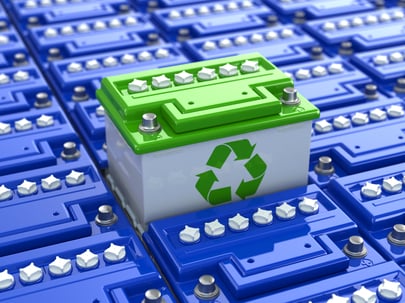
This is something to consider when deciding on the battery type you use to power your forklift(s). Conversely, nearly 100% of lead-acid batteries can be easily recycled, making them the leading battery when it comes to sustainability for many operations.
Regardless of the battery you choose for your electric forklifts, the benefits of electrification are numerous — from reduced fuel costs and reduced TCO, to lower CO2 emissions and less maintenance.
Importantly, when investing in a forklift battery you’ll be prepared for upcoming regulations which forbid the sale of new gas, diesel, and hybrid-powered vehicles.
To get more information about these regulatory changes and ensure that your warehouse is prepared, download our free checklist: 5 Ways to Prepare for 2030.
The utilisation of lithium-ion battery technology has grown exponentially in recent years, as the material handling world becomes more aware of the benefits of this sustainable power source. With next-generation Li-ion batteries and intelligent battery management systems now available as OEM solutions, many operations are finding it easier than ever to switch on higher productivity and lower lifetime costs.
To get more information about these regulatory changes and ensure that your warehouse is prepared, download our free checklist: 5 Ways to Prepare for 2030.
.png?width=50)

