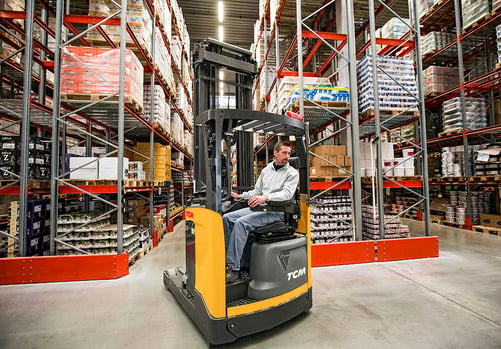
Warehouse space is valuable, and making the most of it can have a significant impact on operational efficiency and long-term costs. For businesses looking to increase storage capacity without expanding their premises, reducing aisle widths can be an effective solution.
However, narrower aisles also create new challenges for material handling. Equipment needs to manoeuvre safely in restricted spaces, access goods at the required height, and maintain productivity without creating bottlenecks.
Choosing the right forklift for narrow aisles therefore starts with understanding your warehouse, not simply comparing truck specifications.
From warehouse aisle width and racking height to load dimensions and picking requirements, several factors determine which type of equipment will deliver the best results.
In this guide, we'll explore how to assess your warehouse layout and compare narrow aisle reach trucks, very narrow aisle (VNA) forklifts, and other material handling solutions.
What Is a Narrow Aisle Forklift?
A narrow aisle forklift is a material handling truck designed to operate in warehouse aisles where space is more restricted than in conventional storage layouts.
These trucks typically feature compact dimensions, specialised steering or lifting arrangements, or other design characteristics that allow them to manoeuvre efficiently between racking.
Common narrow aisle solutions include reach trucks, VNA trucks, and certain compact stackers and order pickers.
The best option depends on how your warehouse is organised and what tasks the equipment needs to perform.
Related: How to Maximise Warehouse Storage with Man-Up VNA Trucks
1. Start With Your Warehouse Aisle Width
Before choosing equipment, measure the space available for safe operation.
Warehouse aisle width is one of the most important factors influencing forklift selection, but the distance between two rows of racking doesn't tell the whole story.
You'll also need to consider:
- The dimensions of the loads being handled
- Turning space at aisle entrances and exits
- Clearance around racking and stored goods
- Pedestrian and vehicle traffic
- The manufacturer's required operating aisle width
For example, a truck may be physically narrow enough to fit between two racks but still require additional space to turn, position its forks, or retrieve a pallet safely.
Always check the manufacturer's specified aisle requirements for the exact truck and load configuration.
If you're planning a warehouse redesign, selecting the equipment and racking layout together can help avoid costly compromises later.
2. Consider Your Racking Height
Narrower aisles often go hand in hand with taller storage systems.
By making better use of vertical space, businesses can increase the number of pallet positions available within the same building footprint.
However, greater lift heights introduce additional equipment requirements.
When assessing your racking, consider the height of the highest storage position, the weight of loads stored at different levels, and the clearance available beneath the roof or other overhead structures.
It's particularly important to distinguish between a truck's maximum lift height and its rated lifting capacity at that height.
Some trucks have reduced residual capacity as lift height increases, so a model's headline capacity may not reflect what it can safely handle at the top of your racking.
The right forklift must be capable of reaching the required height while maintaining sufficient capacity for your loads.
3. Assess Your Load Dimensions and Weight
Not every warehouse handles standard palletised goods.
Some operations regularly move oversized products, unusually shaped loads, or goods with varying weight distributions.
These characteristics can influence which forklift for narrow aisles is suitable.
For example, long or wide loads may require additional manoeuvring clearance, while heavier pallets can affect the lifting capacity required at height.
Consider whether your operation primarily involves full pallet handling, individual case picking, or a combination of both.
This distinction is important because equipment designed for pallet storage and retrieval may not be the most efficient solution for picking individual products.
Understanding your load profile will help narrow down the available truck types before comparing individual models.
4. Evaluate Throughput and Picking Requirements
Increasing storage density is only beneficial if goods remain accessible when they're needed.
A warehouse handling relatively low volumes of pallet movements may have very different requirements from a distribution centre processing hundreds of orders throughout each shift.
Before selecting equipment, assess how frequently trucks travel between locations, how often loads are lifted and lowered, and whether operators need to retrieve complete pallets or individual items.
Consider how your picking strategy affects equipment choice, too.
For example, a warehouse focused on full-pallet movements may prioritise efficient pallet retrieval, while an operation handling mixed orders could benefit from dedicated order picking equipment.
The goal is to balance storage density with throughput, rather than maximising the number of pallet positions at the expense of operational efficiency.
Related: How to Increase Order Picking Speed
5. Narrow Aisle Reach Trucks: Flexible Warehouse Handling
A narrow aisle reach truck is often a practical choice for warehouses that need to maximise storage capacity while maintaining flexibility.
Reach trucks are designed to handle palletised loads in relatively confined spaces. Their extending mast or fork arrangement allows operators to position loads within racking while keeping the truck compact.
They are particularly useful for operations requiring frequent pallet put-away and retrieval at height.
When Does a Reach Truck Make Sense?
A reach truck may be suitable when your warehouse requires:
- Efficient pallet handling in narrow aisles
- Access to elevated racking
- Flexible movement between different storage areas
- Regular pallet replenishment and retrieval
Reach trucks can offer a useful balance between storage density, manoeuvrability, and operational versatility.
However, they still require sufficient space for turning and load positioning, so aisle dimensions must be assessed carefully.
6. VNA Forklifts: Maximising Storage Density
For warehouses where space is particularly restricted, a VNA forklift may offer an alternative.
These specialist trucks are designed to operate in extremely restricted racking aisles, often using guidance systems to support accurate positioning.
Unlike conventional reach trucks, some VNA designs can handle loads without turning the entire truck towards the racking.
This allows businesses to reduce aisle widths further and increase storage density.
When Should You Consider a VNA Forklift?
VNA equipment may be appropriate for warehouses with:
- Very high storage density requirements
- Tall racking systems
- High volumes of pallet movements
- Dedicated storage aisles
- A layout designed around specialist equipment
Some man-up VNA trucks also support order picking at height, making them suitable for operations combining pallet handling with individual item retrieval.
However, VNA systems can require greater investment in equipment, guidance infrastructure, and warehouse planning.
They are therefore most appropriate where the operational and storage benefits justify the additional complexity.
7. Other Narrow Aisle Material Handling Solutions
Reach trucks and VNA forklifts aren't the only options.
For lighter-duty applications, compact electric stackers can provide an accessible solution for lifting and moving pallets in restricted spaces.
They may be particularly useful in smaller warehouses, stockrooms, or operations with less intensive handling requirements.
Order picker trucks are another option where individual item retrieval is more important than full-pallet handling.
Some models are designed for narrow aisles and elevated picking locations, allowing operators to access stock efficiently at different heights.
Choosing between these options depends on the task, not simply the available space.
A warehouse may also benefit from a mixed fleet, using different truck types for pallet movement, replenishment, and order picking.
8. Consider Total Cost of Ownership
Purchase price is only one part of the equipment selection process.
When comparing narrow aisle solutions, consider the total cost of ownership (TCO), including energy consumption, servicing, maintenance, operator training, and expected equipment utilisation.
For specialist VNA systems, warehouse modifications and guidance infrastructure may also influence the overall investment.
Meanwhile, simpler electric material handling equipment may provide a more cost-effective solution for less intensive applications.
The most economical option is the one that meets your operational requirements efficiently over its working life, rather than necessarily the truck with the lowest initial price.
Related: What is the True Cost of your Forklift Fleet?
Which Narrow Aisle Forklift Is Right for Your Warehouse?
The right choice depends on the relationship between your warehouse layout, storage requirements, and daily workload.
A reach truck may provide the flexibility needed for regular pallet handling in narrow aisles. A VNA forklift could be more suitable where maximising storage density and high-level access are priorities. Compact stackers and order pickers may offer better solutions for lighter handling duties or individual item retrieval.
Before making a decision, assess your aisle widths, racking height, load characteristics, throughput requirements, and long-term plans.
By starting with these operational factors, you can identify equipment that supports both warehouse productivity and future growth.
Explore Practical Material Handling Solutions With TCM
Not every warehouse needs the most complex or highest-capacity equipment.
For straightforward, light to medium-intensity material handling applications, TCM's LiTE Range offers practical, accessible solutions designed around simplicity, reliability, and cost-efficiency.
Whether you're reviewing your existing fleet or planning a new warehouse layout, understanding your operational requirements is the first step towards making a confident equipment decision.
Take a look at the TCM LiTE Range to explore material handling solutions designed to support everyday warehouse operations while keeping total cost of ownership in mind.